Quartz Overlay Worktops vs Solid Quartz: An Honest Comparison
Overlays promise the look of quartz in a day for less money. Here is how they compare with solid quartz worktops, and when each one makes sense.

In this article
If you like the look of quartz but not the idea of ripping out your old worktops, a quartz overlay sounds like the perfect answer: a thin layer of quartz bonded over what you already have, fitted in a day, for less money. For some kitchens it is a sensible choice. For many others it is a false economy.
Below, we look at how overlays differ from solid quartz, what they really cost, and how to decide which is right for your kitchen.
What is a quartz overlay worktop?
A quartz overlay is a thin sheet of engineered quartz, usually somewhere between 6mm and 13mm thick depending on the supplier, that is cut to size and glued on top of your existing worktop. The old laminate, wood or tiled surface stays in place underneath and becomes the base. Edges are then covered with a thin strip to hide the original worktop.
Granite overlays and other stone overlay worktops work in the same way, using a thin sheet of granite or engineered stone instead of quartz. Most of what follows applies to all overlay worktops.
A solid quartz worktop is a full slab, normally 20mm or 30mm thick, that replaces your old worktop completely. It is laser templated after the old tops come out, then cut, polished and finished in a factory before being fitted to your units.
Quartz overlay vs solid quartz at a glance
| Quartz overlay | Solid quartz | |
|---|---|---|
| Thickness | Around 6mm to 13mm, on top of your old worktop | 20mm or 30mm full slab |
| What happens to the old worktop | Stays in place as the base | Removed and replaced |
| Fitting | Often a single day | Templating visit, then fitting once the tops are made |
| Joins | More, shorter pieces, so more visible joins | Fewer joins, positioned where they are least noticed |
| Edges | Thin edge strip covers the old worktop | Full range of edge profiles, including mitred and thick edges |
| Sinks | Usually inset sinks only | Undermount sinks and drainer grooves |
| Waterfall ends and splashbacks | Limited | Waterfall ends, upstands and full-height splashbacks in the same stone |
| Weak point | The old worktop underneath, especially near the sink | None hidden beneath |
How much do quartz overlay worktops cost?
Overlays are often sold as half the price of new worktops, but the saving is smaller than it sounds. The quartz itself costs much the same per square metre whether it is thin or thick. What you mainly save is the cost of removing the old tops, and some fitting time.
Once you add cut-outs for the sink and hob, edge strips, any upstands and the work needed if the old worktop is not level, an overlay quote can come surprisingly close to a full quartz replacement. The only way to know is to compare like for like.
Things that change the price of either option:
- The colour and brand of quartz. Plain whites and greys cost less than heavily veined or premium designs.
- The number of cut-outs: sink, hob, tap holes and drainer grooves.
- Edge profiles, islands, waterfall ends and splashbacks.
- How easy the kitchen is to access and fit.
See our range of quartz worktops and how buying from us works.
Are quartz overlays any good?
Overlay worktops are popular as part of a quick kitchen makeover, often alongside new kitchen doors. They can be good, in the right kitchen. A good overlay, fitted on a sound, level worktop, gives you a quartz surface quickly and with very little mess. The problems come from what is underneath.
What overlays do well
- Speed. Many overlays are fitted in a day, with no need to remove the old tops.
- Less disruption. No removal, less dust, and your kitchen stays usable.
- The same surface feel. On top, it is quartz: non-porous, easy to clean and resistant to stains. Like any quartz, it is not fully heat resistant, so use a trivet for hot pans. A hot cup of tea is fine.
Where overlays fall short
- Water near the sink. Joins and edges around the sink and dishwasher are where water can find its way into the old chipboard worktop underneath. Once it swells, the overlay above can lift or crack.
- Extra height. The worktop gets taller, which can affect the hob, slide-in appliances, upstands and the tiles behind.
- Fewer design options. Thin overlays cannot easily take undermount sinks, drainer grooves, thick or mitred edges, or waterfall ends.
- Old problems stay. If your units or worktop are out of level, damaged or already swollen, an overlay covers the problem rather than fixing it.
Things that are easier with solid quartz
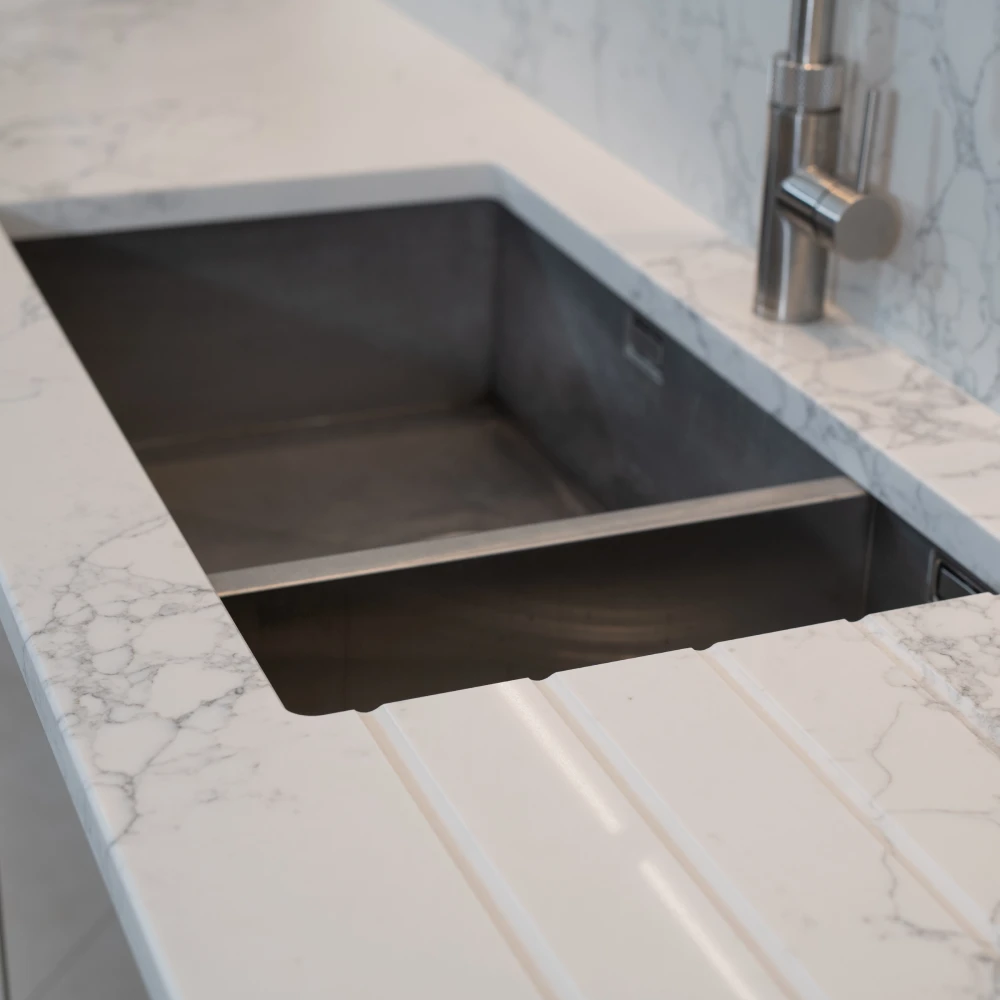
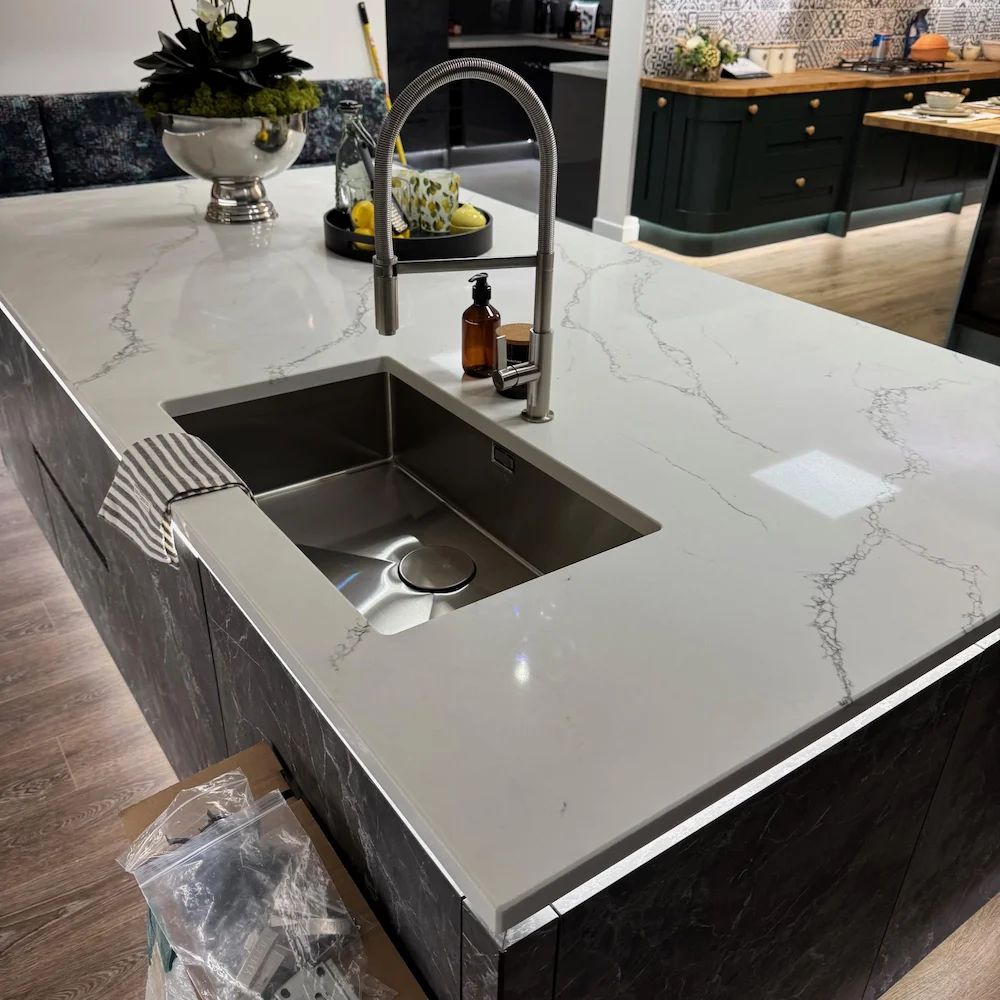
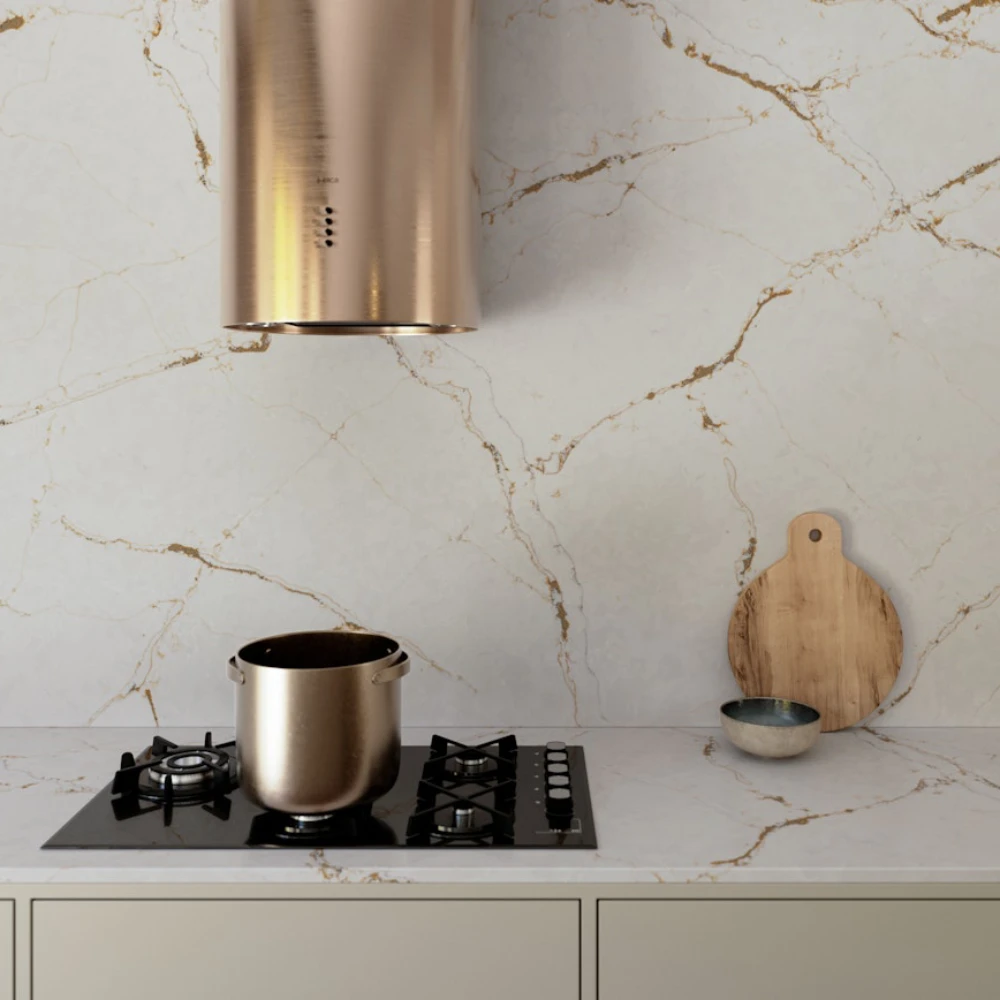
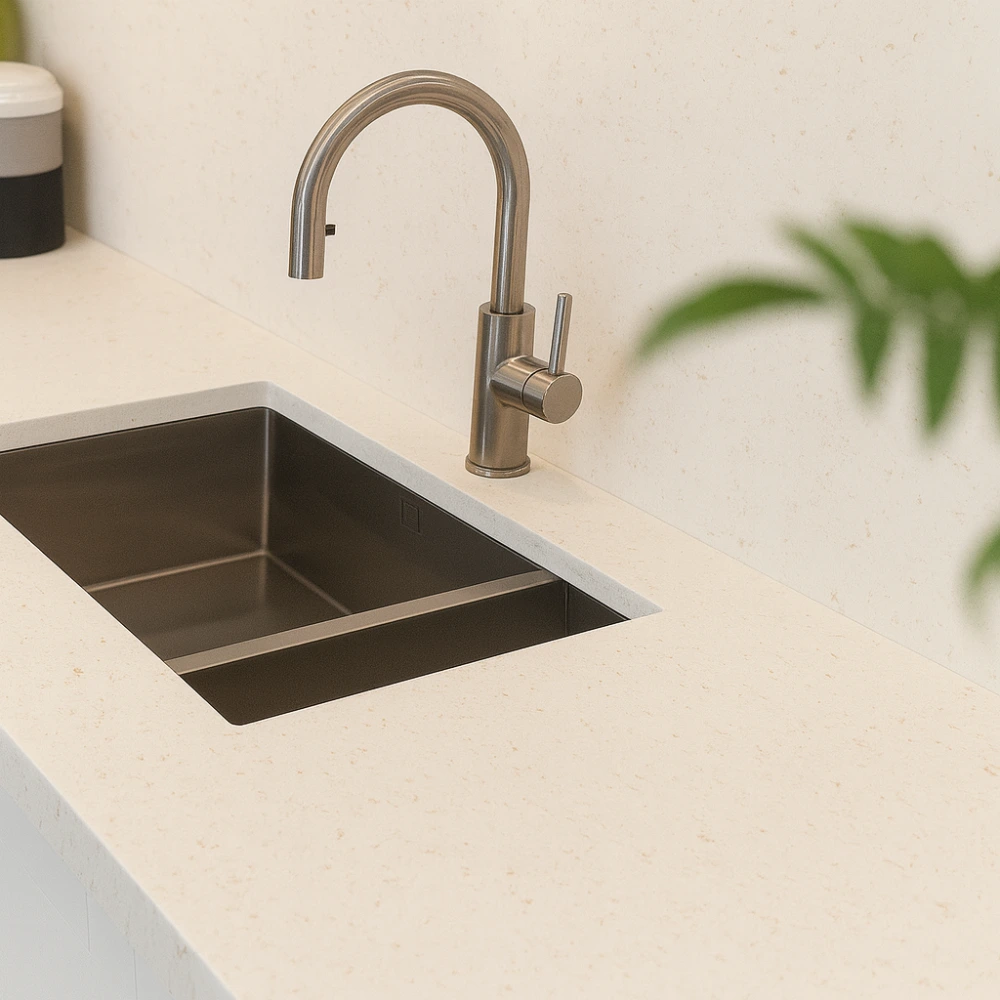
Because a solid worktop is made from scratch for your kitchen, it opens up details that are difficult or impossible with an overlay:
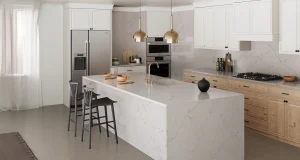
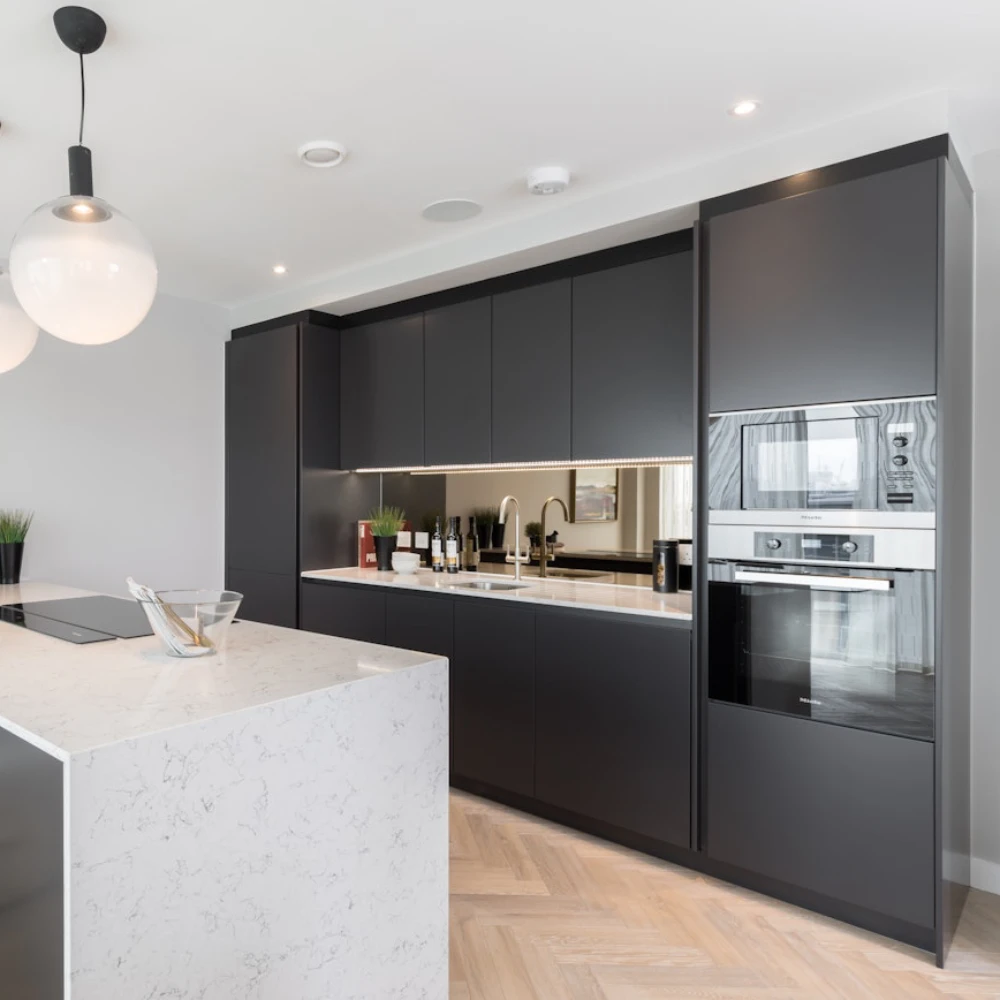
- Undermount sinks, which sit below the worktop so you can wipe straight into them, as with Armani Grey above.
- Drainer grooves cut and polished into the stone beside the sink.
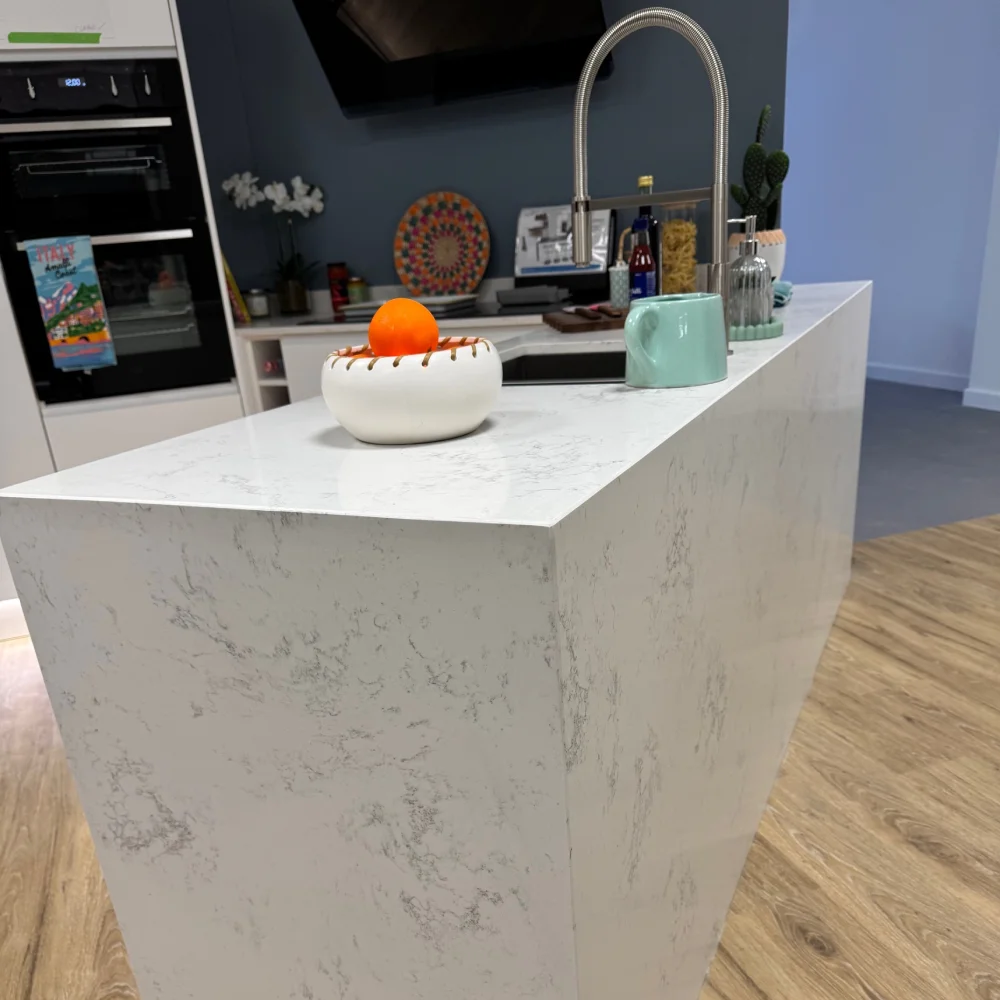
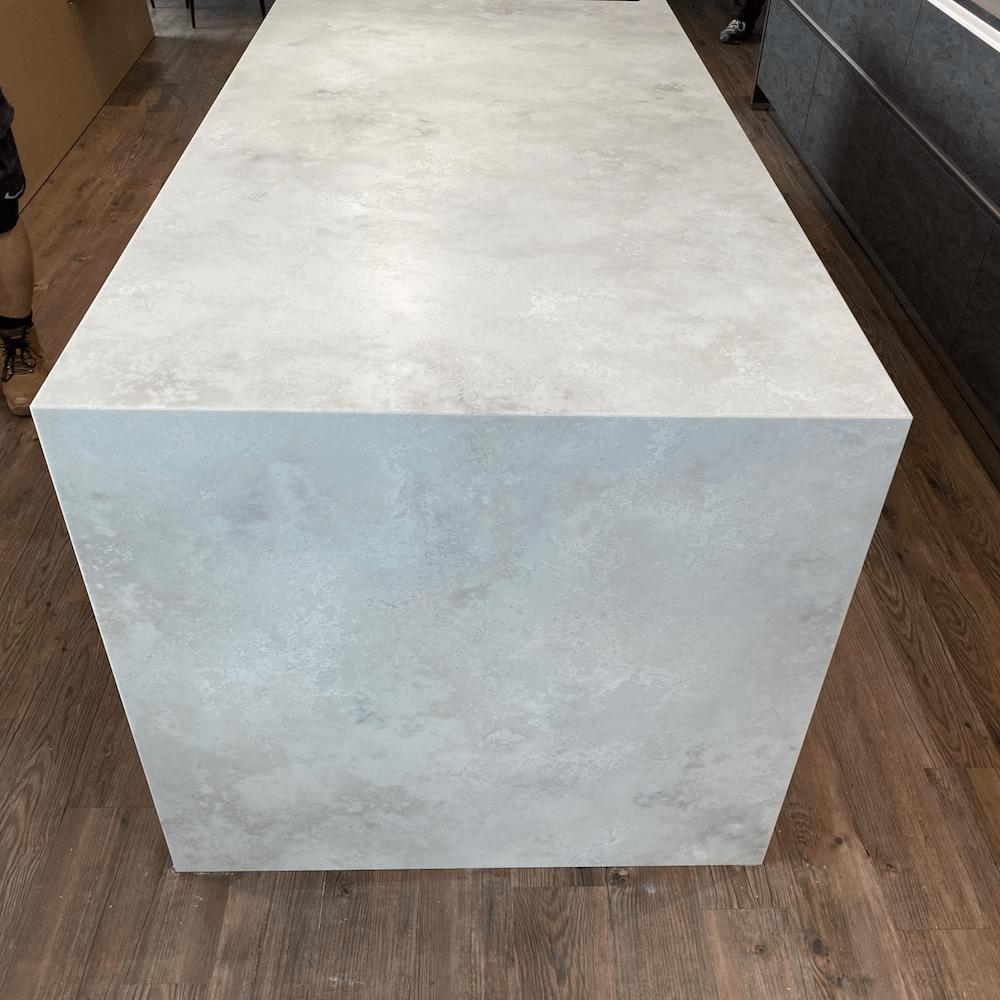
- Waterfall ends, where the stone runs down the side of an island to the floor.
- Matching upstands and full-height splashbacks, cut from the same slab so the veining carries on, as with Versailles Ivory.
- Thicker and mitred edges that give a chunkier, more substantial look.
When an overlay makes sense, and when it does not
An overlay can be a good choice if
- Your existing worktop is solid, level and dry, including around the sink.
- You are happy with an inset sink and a simple edge.
- You are refreshing a kitchen you plan to replace in a few years, or preparing a property to sell or let.
- Keeping disruption to a single day matters more than anything else.
Solid quartz is the better choice if
- You plan to stay in the house and want the worktops to last as long as the kitchen.
- Your old worktop is damaged, swollen or out of level.
- You want an undermount sink, drainer grooves, an island with a waterfall end or a matching splashback.
- You are also changing the hob, sink or appliances, so the old tops would need cutting anyway.
Compact laminate vs quartz
Compact laminate is the other option people weigh up when they want a slim, modern worktop for less. It is a dense, solid laminate, usually around 12mm thick, and it is tough and water resistant. The difference is in the look and feel: quartz is stone, with real depth to the colour and veining and a cool, solid feel, while compact laminate is a printed decorative surface. If you want the look of marble or stone that stands up to close inspection, quartz is the closer match.
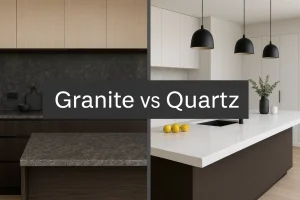
If you are still choosing a material, our guide to granite vs quartz worktops compares the two most popular stone options, and our kitchen worktop colour ideas show what suits your cabinets.
How long do overlay worktops last?
The quartz on top is just as hard wearing as a solid quartz worktop. How long an overlay lasts depends on the worktop underneath and on the joins. On a dry, sound base with well-sealed joins it can last for many years. Where water gets into an old chipboard worktop, problems can appear much sooner. A solid quartz worktop has no hidden base to fail, and with normal care should last as long as your kitchen and longer.
What replacing your worktops with solid quartz involves
Replacing worktops is less disruptive than most people expect, and it does not mean replacing your kitchen. The usual process is:
- Quote. Send us your plans or measurements and choose a colour.
- Templating. We laser template your units so every top fits exactly. See our measurement guide.
- Fabrication. Your worktops are cut, edged and polished, with cut-outs and any drainer grooves added.
- Fitting. The old tops come out and the new ones go in, usually in a day for a typical kitchen.