Are Quartz Worktops Safe? Silicosis Explained by a Stone Fabricator
Silicosis has made quartz worktops front page news. As the people who cut the stone, here is our honest answer on who is at risk, who is not, and how to buy safely.


In this article
If you have seen the headlines about “killer kitchens”, you may be wondering whether the quartz worktop you are planning, or the one already in your kitchen, is putting your family at risk. It is a fair question, and most of the articles about it are written either by safety campaigners or by companies keen to sell you something else.
We are neither. We are the people who cut the stone. Silica dust is a risk we manage in our own workshops every working day, so this guide sets out plainly who is at risk, who is not, what has changed in the UK in 2026, and the questions to ask before you let anyone fabricate or fit a stone worktop for you.
What is silicosis, and what does it have to do with worktops?
Silica is one of the most common minerals on earth. It is in sand, most rocks, bricks, concrete and tiles, as well as in stone worktops. On its own, in a solid surface, it is harmless.
The problem starts when silica-containing materials are cut, ground, drilled or polished. That work creates very fine dust, called respirable crystalline silica (RCS), small enough to reach deep into the lungs. Breathing in high levels of RCS over time can cause silicosis, a scarring of the lungs that cannot be cured, as well as lung cancer and COPD. The Health and Safety Executive (HSE) puts it simply: silicosis is incurable, but it is entirely preventable.
Engineered stone, the material most people call quartz, is made mostly of crushed quartz bound with resin. According to the HSE it can contain up to 95% crystalline silica, which is more than most natural stones. That is why engineered stone has been at the centre of the news, and why the people who fabricate it need stronger controls than almost anyone else in construction.
Who is at risk, and who is not
| Who | Risk from silica dust | Why |
|---|---|---|
| You and your family, living with a fitted worktop | No dust risk | A finished worktop is a solid, sealed surface. Cooking, cleaning, chopping and everyday use do not release silica dust. |
| You, if you cut, drill or grind stone yourself | Real risk | Cutting with a grinder or saw indoors without water or extraction creates exactly the dust the HSE warns about. Leave it to professionals. |
| Fitters cutting on site in your home | Risk if uncontrolled | On-site cuts should be kept to a minimum and done with water or on-tool extraction, ideally outside. |
| Workers in fabrication workshops | Highest risk if uncontrolled | Daily cutting, shaping and polishing. Dry methods expose workers to far more dust than wet methods. |
So the honest answer to “is a quartz worktop safe?” is yes, for the people who live with it. The question worth asking is whether it was made safely, because that is where the harm happens.
What has changed in the UK in 2026?
Quartz worktops are not banned in the UK. At the time of writing (October 2026) you can still buy, fabricate and fit engineered stone legally. What has changed is how strictly the work is policed.
The law itself has not moved. Under the Control of Substances Hazardous to Health (COSHH) Regulations, employers must already control exposure to silica dust, and the workplace exposure limit for respirable crystalline silica in Great Britain is 0.1mg/m³ averaged over an eight hour day. The difference in 2026 is that the HSE has spelled out what that means for engineered stone, and is checking.
| When | What happened |
|---|---|
| July 2024 | Australia banned the manufacture, supply and installation of engineered stone, the first country to do so. It is the reason the UK debate grew louder. |
| January 2026 | The Worktop Fabrication Federation (WFF) launched its Quality Mark, an independent check that a fabricator controls silica dust and looks after its workers’ health. |
| May 2026 | The HSE published its first guidance written specifically for engineered stone. It states that dry cutting of engineered stone is unacceptable, and asks employers to use lower-silica materials where they can, water suppression at the tool, suitable respiratory protection and regular health checks for workers. |
| 2026 to 2027 | The HSE began a campaign of more than 1,000 inspections of worktop fabricators across Great Britain. By the end of May 2026 it had already ordered four businesses to stop working with engineered stone until they fixed their controls. |
In other words, the UK has chosen to make the work safe rather than ban the material. That puts the responsibility firmly on fabricators, and it gives you, the buyer, a good reason to check who you are buying from.
How we keep silica dust under control

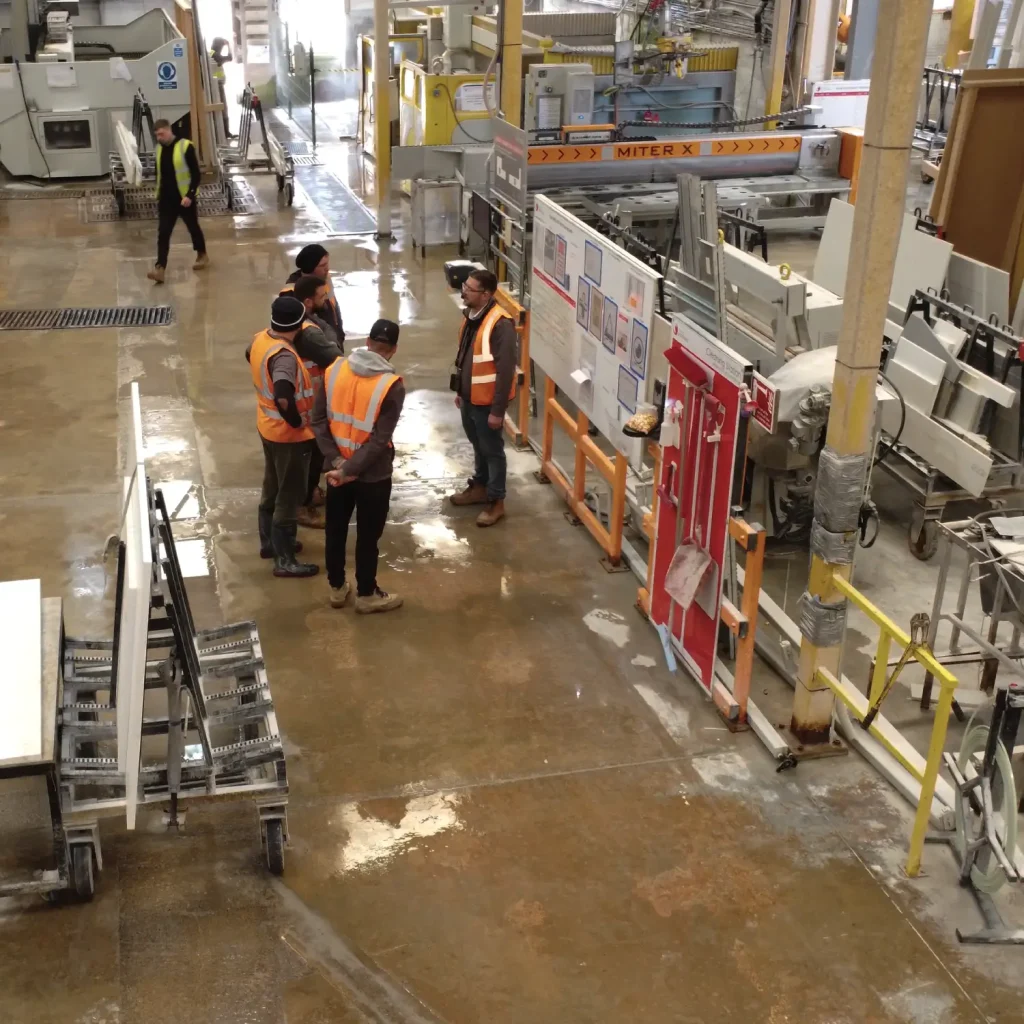
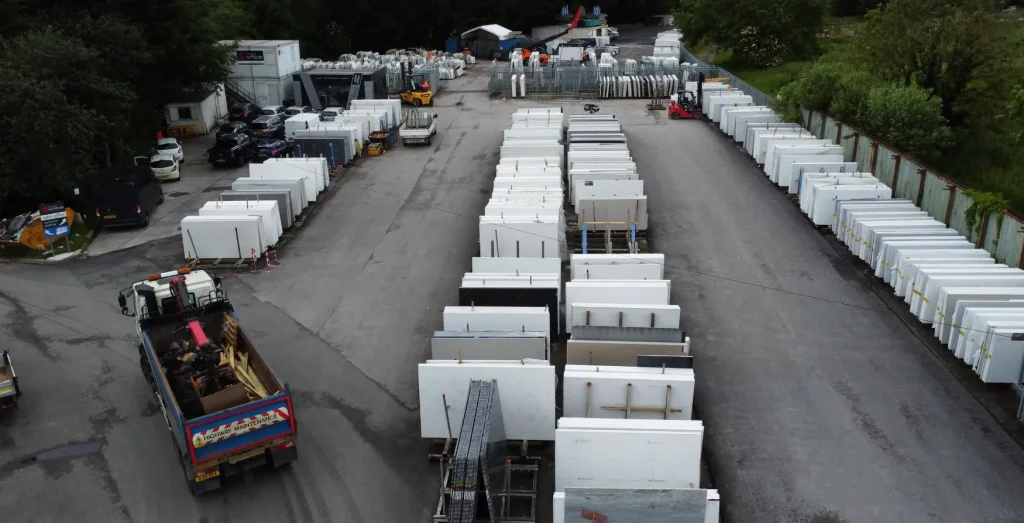
We have been fabricating stone worktops in Derbyshire since 2001, and today our workshops cover 250,000 square feet. Everything that creates dust, from cutting slabs to size to shaping edges, sink cut-outs and drainer grooves, happens in our factory under controlled conditions, not in your kitchen.
- WFF Quality Mark for Safe Working Practices. In May 2026 we became one of the first fabricators in the UK to be awarded it. It means an independent, professionally registered occupational hygienist has assessed how we control silica dust, and that we commit to enhanced health surveillance for our team.
- ISO 45001:2018 certification for occupational health and safety management, alongside ISO 9001 and ISO 14001 and more than a decade of CHAS and SMAS accreditation.
- Precise templating so worktops arrive ready to fit. Laser templating means far fewer adjustments on site, and fewer cuts in your home. See our measurement guide.
Five questions to ask any worktop company before you buy
These are the questions we would ask if we were buying a stone worktop. A good fabricator will answer all five without hesitation.
- Do you hold the WFF Quality Mark? You can check any fabricator on the Worktop Fabrication Federation website. If a company only sells worktops and someone else makes them, ask who fabricates them and check that business instead.
- Do you cut, shape and polish with water or extraction, never dry? The HSE now says dry cutting of engineered stone is unacceptable. Anything less than a clear yes is a red flag.
- How much cutting will happen in my home? Cut-outs, edges and drainer grooves should be done in the factory. Ask how any small adjustment on fitting day will be handled.
- If something must be cut on site, how will you control the dust? Look for water-fed tools or on-tool extraction with a proper vacuum, work done outside where possible, and no dry sweeping afterwards.
- Do you offer lower-silica materials? Several brands now make lower-silica ranges, and porcelain and natural stone are alternatives. Ask which colours fall into these, if it matters to you.
Should you avoid quartz worktops?
Not because of how it behaves in your kitchen. A fitted quartz worktop is hygienic, non-porous and does not need sealing, which is why it remains one of the most popular choices in the UK. If you like quartz, choose it, and choose a fabricator who makes it safely.
If you would rather avoid engineered stone altogether, you have good options:
- Lower-silica quartz. The look and practicality of quartz, with less crystalline silica in the slab. Ask us which of our quartz worktops qualify.
- Porcelain and sintered stone. Very hard, heat resistant and stain resistant. See our porcelain and ceramic worktops.
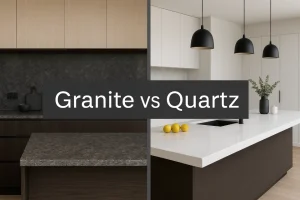
- Natural granite. Granite also contains silica, so it needs the same care when it is cut, but generally less than engineered stone. Compare the two in our granite vs quartz guide.
Whatever you choose, the same rule applies: every stone and stone-like worktop needs to be cut safely, so the fabricator matters more than the material.
Everyday questions about quartz and silica
Can you get silicosis from a quartz worktop in your kitchen?
No. Silicosis comes from breathing in fine dust over time, and a fitted worktop does not produce that dust in normal use. The risk only arises if the stone is cut, ground or drilled.
Is it safe to clean, chop on or put hot things on quartz?
Cleaning and chopping are safe. Use a chopping board to protect the surface and your knives, and a trivet under hot pans, because very high heat can mark the resin in quartz. None of this releases silica dust. Our aftercare guide covers looking after your worktop.
What about when the worktop is removed one day?
Lifting out a worktop in one piece is not the problem. Breaking it up or cutting it is. When the time comes, ask the installer how they will remove it, and do not let anyone cut or grind it indoors without dust controls.
Are quartz worktops being banned in the UK?
Not at the time of writing. Some unions and doctors have called for a ban like Australia’s, and the position could change, but the current approach is stricter guidance, inspections and enforcement against fabricators who do not control dust.